
Thank you for visiting HOJO website. If you have any enquiry, please feel free to get in touch with us at

▼ Akira Hojo
▼ Hojo Newsletter
▼ HOJO FACEBOOK






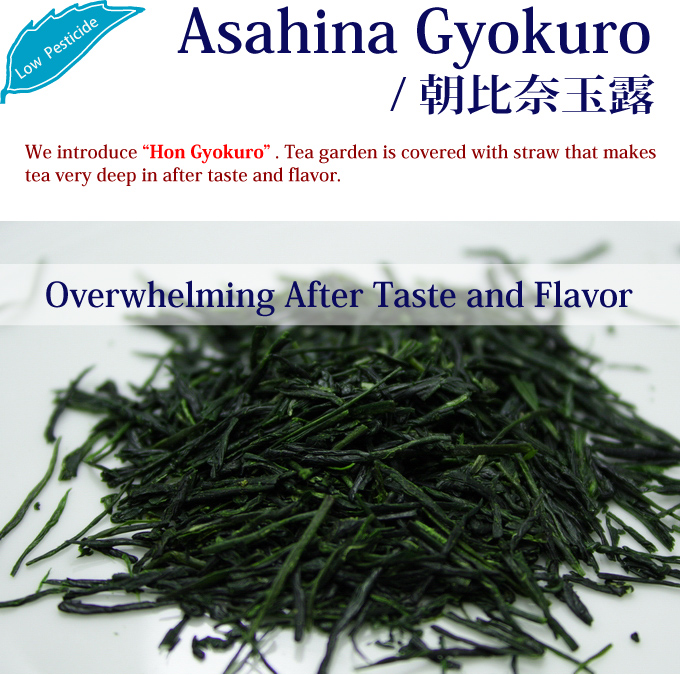
The characteristic of Gyokuro is totally different from Sencha. Gyokuro shouldn’t be defined as the superior version of Sencha; it is a completely different category of Japanese green tea.
What are the distinctive characteristics of Gyokuro?
Firstly, the Gyokuro tea leaves are very deep green in color. Secondly, its flavor is like seaweed and has a mellow, sweet and full bodied taste.
In fact, the same cultivar that produced Sencha can be used to produce Gyokuro. The secret is that the farmer has a very special method when producing tea leaves for Gyokuro. About 20-30 days in advance before plucking of the tea leaves, the entire tea garden will be covered by sheet. Under the sheet, the tea trees are shield from direct sunshine. When seriously lacks sunshine, tea trees will trigger a chain of physiological changes within itself in order to survive. The tea leaf is not only physically changing, the chemical composition in the leaves also changed. As a result, tea leaves produce the typical flavor substances of Gyokuro and extremely rich in minerals. We select our Gyokuro from Shizuoka, Okabe Town of Shizuoka Prefecture where it is surrounded by clean air and transparent alpine water. We call it Asahina Gyokuro.
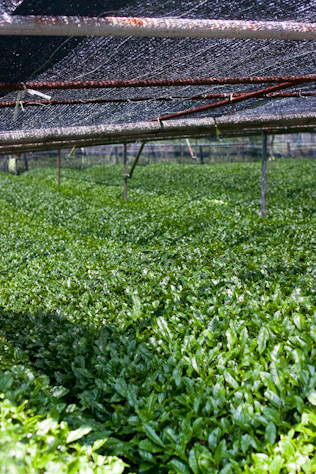
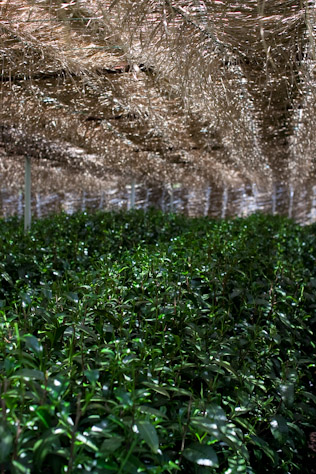
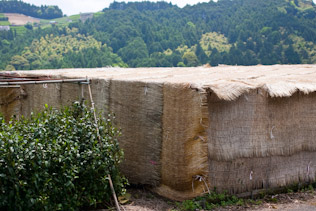
Above is just an ordinary introduction of Gyokuro. We selected the “Hon Gyokuro”. “Hon” in Japanese means genuine or authentic. Perhaps authentic is more suitable for this meaning. The name Hon Gyokuro is given only for the tea that is produced from the tea garden covered with “straw”. This is a traditional method applied for the production of Gyokuro and it is hardly practiced in most of the modern tea gardens nowadays. At present, almost more than 90 percent of the Gyokuro tea gardens are covered by black sheet that is called “Kanreisha”.
In general, there are 3 major categories of tea that is grown under coverage.
The taste and flavor of Hon Gyokuro is remarkably different from ordinary Gyokuro. Hon Gyokuro gives a very strong aftertaste. Once drink, you find its flavor amazingly long lasting and taste lingers on your throat for a long time. You feel a kind of sweetness that stays very long in your throat. For ordinary Gyokuro, Umami characteristic is often being emphasized. Umami is contributed by amino acid content in tea leaves. However, Umami does not impress us unless it comes with deep aftertaste. Eventually ordinary Gyokuro gives a flat taste with overwhelming umami, while Hon Gyokuro gives a very long lasting flavor and taste on top of Umami characteristic.
The reason why the Hon Gyokuro gives a long lasting aftertaste is because of the straw used to cover the tea garden. These straws are very rich in minerals. When rain falls, water that soaked through the straws on top of the tea garden will supply additional minerals onto the ground. The extra minerals from the straw will drastically improve the quality of soil and eventually the quality of Hon Gyokuro becomes so much different.
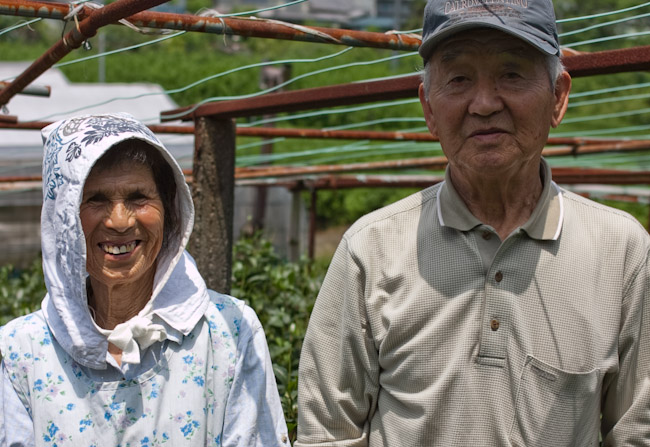
Mr.Omura and his wife: There are only a few famialies who produce Hon Gyokuro at the moment. He worries if there is no one who continue Hon Gyokuro production in future since most of younger generation shift their production to the modern method.
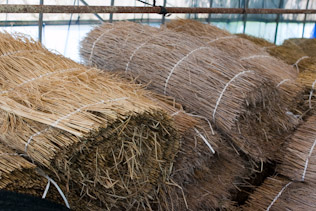
For our Hon Gyokuro, there is another factor that makes our quality different. The tea garden that produces our Hon Gyokuro uses not just straw, but it must be fresh straw. According to Mr. Omura who is the owner of Hon Gyokuro tea garden, the fresh straw is a very crucial factor. According to him, when he chews the fresh straw, it tastes sweet as it is rich in minerals. On the other hand, the recycled straw from previous year does not retain sufficient minerals. Just because of he has to get sufficient supply of fresh straws every year, he also owns a rice field in large scale. It is his wife’s job to produce sheet using straws. Nowadays straw sheet is very expensive to purchase, yet if they produce it by themselves, it takes a lot of efforts and time. This is one of the reasons why most of tea gardens switch to using plastic black sheet.
There is another reason why the most farmers choose to produce ordinary Gyokuro.
In Japan, ironically ordinary Gyokuro is highly priced. It is the dilemma and discrepancy exists in Japanese tea market. In Japan the earlier the tea is plucked in season, the better the price it is given. The growing speed of Hon Gyokuro is purposely slowed down in order to raise its quality. Somehow ordinary Gyokuro comes out much earlier in the season. This dilemma is also caused by the misunderstanding of Japanese tea merchants who believe that Umami is the index of quality. As a matter of fact, it is not Umami that sets the quality but the minerals.
Under the circumstances, Hon Gyokuro seldom comes out in the tea market. It is not worthwhile that the farmers spent a lot more time and effort in taking care of the crops, yet lower price is given. Usually Hon Gyokuro is directly sold to the specialty tea shop that understands and appreciates its value.
 |
 |
|
Ordinary Gyokuro Garden which is covered with black sheet |
Hon Gyokuro Garden which is covered with straw |

Okabe Town is located north west of Shizuoka Town. The alpine river called Asahina River runs through the town, and both sides are surrounded by very steep mountains. The Asahina District which is located at the north of Okabe Town has hilly lands, and thanks to the typical mountain weather, it is suitable for producing good quality tea. Tea is produced here since the Muromachi Era. The Gyokuro was invented in year 1835. In old days, Gyokuro tea garden was covered by the bundles rice straw. Nowadays, Asahina (Shizuoka), Uji (Kyoto) and Yame (Fukuoka) are three major Gyokuro manufacturing areas in Japan.
Around 30 days in advance before plucking the leaves, Gyokuro tea garden is covered. The penetration rate of sunshine in the beginning of 7-10 days is 65-70%, and from then onwards the penetration rate is 97-98%. The theanine which is a kind of amino acid is produced from the root and is transferred to the stem and leaves. Theanine is the substance contributing to the umami and sweet taste in green tea. Green tea which contains higher percentage of theanine gives a amino acid taste which is called Umami in Japanese and nowadays also in English. On the contrary, tea leaves which contain a higher proportion of polyphenol such as catechin gives a bitter taste. When tea leaves are exposed to sufficient sunshine, theanine is degraded and converted into catechin. Therefore, blocking out the sunshine will inhibit the biosynthesis of catechin and theanine is proportionally increased. In other words, the typical taste of Gyokuro is made by blocking out the sunshine from the tea leaves.
The typical aroma of Gyokuro which is often associated to seaweed is composed by the substance named dimethylsulphite. The precursor of dimethylsulphite is called methylmethioninesulphonyl. This substance is also accumulated in tea leaves when the tea garden is blocked from sunshine. During this process, the tea leaves get steamed, which in turn produces a substance called dimethylsulphite that gives typical seaweed flavor.
The brewed Gyokuro leaves are very deep green in color compared with Sencha which is yellowish green in color. When the tea garden is covered and no sufficient sunshine reaches the tea leaves, it will rise to the surface of the tea leaves and produce more of chlorophyll, the green pigment in tea leaves, in order to carry out photosynthesis. This is the reason why the color of Gyokuro is a deep green shade.
 |
 |
|
Hon Gyokuro Tea Garden |
For covering tea garden, it is essential to use fresh straw. The one on the left is fresh straw, while the one on the right is old batch. The outcome is completely different depending on the quality of straw. |
Asahina Gyokuro is mainly produced from the cultivar called Yabukita. The leaf is plucked by hand, therefore, the tea bush in the tea garden is not cut into “table-shape” but standing up.
Starting from the end of April till beginning of May, the first flush is plucked. For Hon Gyokuro, the timing of plucking is later than ordinary Gyokuro. The plucking is usually carried out in the middle of May. The plucking is based on the standard of one bud and 3 leaves. It is important to include the third leaf. The third leaf stay with tree much longer than young leaf. Hence it contains more minerals and polyphenols. This is essential to gives a strong flavor and thick body in taste.
The leaf is plucked after sunrise in order to avoid the morning dew. If morning dew remains on the leaves, the tea leaves will be over heated during the steaming process. As a result, the tissues of the tea leave will be excessively destroyed and will not be able to produce fine quality tea leaves.
 |
 |
|
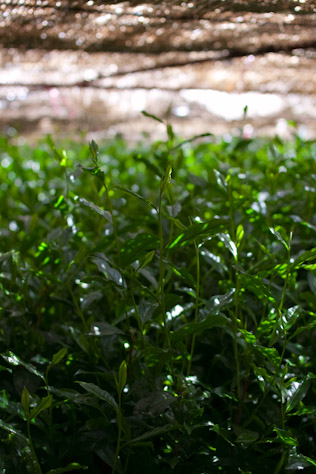
Tea leaf at Gyokuro garden just before plucking |
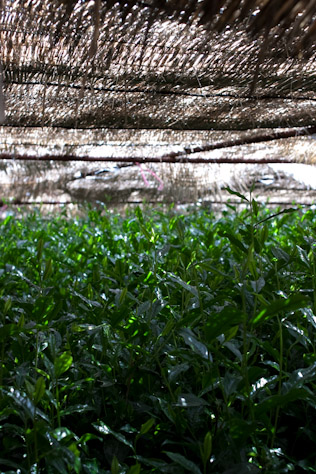
The tea leaf for Gyokuro turns into deep green color |
The process of Gyokuro is basically the same as Sencha. However, the leaf of Gyokuro contains more moisture and is tender, therefore extra care is required during handling.
Tea leaves plucked from different tea gardens is segregated. Different tea gardens carry different lot numbers and will not be mixed in order to establish their clear traceability.
Fresh tea leaves of Gyokuro contains high moisture and the leaves are very tender. Steaming is conducted only for 20 seconds which is shorter than Sencha. Applying a high temperature in steaming for short time consistently, will result in the the finished tea leaves product to be completely dried and it contains no condensed moisture.
Tea leaves has to be quickly cooled down and at the same time evaporate the moisture. Immediate reduction of the wet heat is very important to avoid secondary heating of tea leaves.
Effectively drying by agitating the tea leaves under the hot air. At the same time, mixing will soften the leaves.
This is the only process conducted without heat. The machine moves in circular motion with pressure that spread the moisture of the tea leaves evenly. The tea leaves generate heat due to the friction. Therefore, at regular intervals it is necessary to loosen the tea leaves to release the heat.
A rotary dryer is used, gently rolling the tea leaves to promote drying; reducing moisture, and twists the tea leaves into a finer shape.
It is a reciprocal movement of the back and forth motion, combined with circular movement twisting the tea leaves into a needle shape. High quality Sencha appeares to be dark green in color, shinny and solid.
After the final rolling, tea leaves still contain moisture. Further drying will necessary to reduce the moisture up to 5%. These leaves are called Aracha (crude tea). Areca does not undergo the firing process. Comparing with the finished product, the flavor of fresh leaves and bitterness is very strong.
The purpose of firing is as below:
Each tea wholesaler will purchase Aracha as raw material, and based on their individual process, they will conduct firing. This is how they create their original quality. Subsequently, they will blend a few kinds of tea and create a wholesaler’s original brand.
However, in most of cases, Gyokuro is not fired in order to retain its original characteristic.
Unlike the Sencha process, Gyokuro is not introduced to the market during spring right after its production. It will be kept for a few months from autumn to winter in order to get tea leaves well matured which will make it taste very mellow and sweet.
The characteristic of Gyokuro is deep umami and sweetness. It is very thick and has a soupy like consistency, with a very sweet after taste. Please note that the brewing method of Gyokuro is very different from Sencha.
In you are using tap water, it is necessary to filter the water using an activated carbon filter. If not, you wouldn’t be able to enjoy the authentic taste of tea. Chlorine is added to tap water in order to sanitize bacteria. This chlorinated water will also harm our body cells. Concerning about our health condition, it is very important to remove chlorine from drinking water. The most effective method in removing chlorine is to install an activated carbon filter. This type of filter is designed for removing organic substance. It will remove not only chlorine, but also other harmful substance such as contaminated pesticide. The activated carbon filter can be easily obtained from the common hardware shop in most countries. If activated carbon filter is not available, please place a charcoal inside the water and leave it for over night. The material composed of activated carbon filter is made of ground charcoal. The difference is that activated carbon filter contains much finer particles and hence it has extremely large surface area for a better efficiency in filtration. We do not suggest RO water (reversed osmosis water) or distilled water. This water carries no mineral, the taste and flavor of tea tends to be very unstable, unless you have very superior quality tea and tea equipment.
In the long run, you may observe a thick layer of scale accumulated inside your kettle. Our mother usually taught us to wash and remove it with citric acid. But please do not even try to remove the scale. Scale consists of minerals that exist in the water. The mineral composition is reflected from the water you used. If you remove the scale, the mineral ion balance between scale and water is destroyed. This balance is called buffer effect in science. The flavor and taste will seriously run out and you won’t be able to get previous taste and flavor for a long time. It is also important to stick to the same type of water whenever brewing tea. If source of water is changed, it carries different type of minerals. It will affect the mineral ion balance too.
Go to further information about suitable water for brewing tea >>
We recommend 2 different styles of brewing. 1. Traditional style and 2. Modern style. The traditional style uses less water, extremely lower temperature and long brewing time. It gives very thick taste like soup and strong body. As for modern brewing method, we follow almost the same method as brewing sencha. Use less quantity of leaf, higher temperature and shorter brewing time than brewing sencha. It gives very strong flavor and gentle sweetness. Based on my experience serving Gyokuro to many customer, majority of my customer enjoy morden brewing method.
About 6g of tea leaf for 100ml of water. Tea is drunk in very high concentration.
It is important not to use boiling water. Boiling water should be poured into an empty glass or any container and let it cool down until about 50 degree C. It is as low temperature as shower.
The brewing time is about 2 minutes. The second brewing is for less than 10 seconds at the same temperature. Customer tends to feel that less than 10 seconds may not be long enough. However it is sufficient since leaf has been soaked in hot water while tea leaf is left inside teapot. Second brewing is the most critical brewing. If you brew too long at 2nd brewing, you would not be able to enjoy the rest of brewing.
Traditionally, a pitcher is not used for brewing Japanese tea. Tea is directly poured from the tea pot into respective tea cups. In order to make the concentration evenly, we have to pour one cup after another,a few times until the last drop of tea. The purpose of pouring until the last drop is to extract the concentrated liquor. This is important as tea leaves must be filtered well and kept without water to avoid the liquor becoming bitter and stewed. Besides, it prevents tea leaves from being over cooked. In addition, tea after filtration will be ready for second brewin. However the usage of pitcher is highly recommended as it is very practical for brewing nice cup of tea. With the pitcher, you can mange to keep teapot always empty as soon as brewing is completed.
After pouring the tea, you have to make sure leave the lid open to avoid further steaming of tea leaves.
Banko purple clay and Tetsubin makes the taste of Gyokuro even better. It is mainly thanks to the iron that released from the equipment. The iron enhance the depth of after taste in particular.
The quatity of tea leaf can be calculated by the formuma that "Divide the Volume of Water by 5". For example: the volume of teapot = 200ml; 200ml/50 =4g. You need to measure 4g of tea leaf for 200ml of water. On the contrary to the traditional brewing method, use more volume of water. Teapot that size is in about 150-220ml is just nice for one person.
Cool boiling water down to 70-80 degree C. Stick to the same temperature over the series of brewing until you feel taste is no long remaining. At last increase brewing temperature so as to bring out the remaining taste and flavor.
Gyokuro leaf is much more tender than sencha leaf. Brewing time should be slightly shorter than how we brew sencha. For sencha, the first brewing is for 1 mins For Gyokuro, 30 seconds to 40 seconds is long eough. The second brewing must be kept less than a few seconds. The theird brewing also the same. From the forth brewing, increase to 10 seconds and for the each subsequent brewing add additional 10 seconds.
Banko purple clay and Tetsubin makes the taste of Gyokuro even better. It is mainly thanks to the iron that released from the equipment. The iron enhance the depth of after taste in particular. For this brewing method, we also recommend red clay teapot. With higher temperature, aroma and flavor comes up more intense which synclonizes with the character of red clay.
Most of Green Teas can be brewed in cold water. The higher the grade, the more suitable it is with cold water brewing. In particular, Gyokuro is second to none when it comes to cold the water brewing.
1. Measure 1 table spoons of tea leaves for 500 of water.
2. Pour in water into glass jar or bottle and leave it for more than 30 mins. It is also good idea to put tea leaf directly into Pet Bottle.
3. Very gently stir the container in order to even out its concentration.
4. Usually the taste of tea is getting thicker when it is brewed for more than a few hours. In this case, top up additional water. Eventually tea can be brewed more than 1 liters per 1 table spoons.
1. Measure 4-6g of tea leaf for 200ml of water.
2. Pour water into clay teapot and brew it for 3 mins.
3. For second brewing, brew for 20 seconds. Alternatively you can also swtich to hot water from second brewing onwards, if you wish. With hot water on second brewing, pour boiling water and brew for less than a few seconds. Since tea leaf is very cold and wet, the temperature drastically drops to less than 60 degree.
The benefit of cold water brewing is Tea can last for whole day and the taste is natural sweet and refreshing. Thanks to the cold water extraction, the level of caffeine in tea is extremely low. You would not suffer from sleepless night. It can be
even enjoyed by kids.
Once a bag of tea is opened, please finish it within 3 months if you wish to enjoy its freshness. From the medical point of view, it is safe to consume the tea even if it is kept for a few years. However the freshness disappears if it is kept for too long. Tea must be tightly sealed before it is kept. Tea should be kept in ambient and dry conditions such as in the living room, but it must be completely away from humidity. Tea should not be kept in the kitchen as the environment is very humid. Avoid enclosed area such as inside the cupboard or drawer as these places are damp. Also avoid opening the bag of tea in humid atmosphere. It is recommended to open the bag during a sunny day or under air-conditioned atmosphere. Once tea leaves absorb moisture, deterioration of tea will be triggered within a few days. Tea will then give an astringent taste, sometime it tastes sour. The fresh aroma also becomes weaker.
The quality of tea lasts longer if it is kept in the fridge. However we strongly recommend you not to keep tea in the fridge. When tea is withdrawn from the fridge, there is usually condensation. Once tea is exposed to moisture during condensation, the quality will deteriorate within a few days. The higher moisture content in the tea leaves will trigger oxidation and it will completely destroy the quality of tea.
Here’s one frequently asked question: what happens if bag is sealed using tape or tea is packed in zipper bag and kept inside the fridge?
For your information, these simple sealing methods are not sufficient. When the bag is withdrawn from the fridge, it is cold inside the bag and therefore causes negative pressure. Air will be drawn from outside and condensation will occur. In addition, if the bag is taken in and out from the fridge very often, this will cause heat stress to the tea leaves as temperature is increased and decreased very frequently. If tea is kept in the fridge, when it is withdrawn from the fridge, it is necessary to leave it in ambient atmosphere for more than 24 hours in order to warm up the tea leaves. Based on our experience, 12 hours is not long enough. We may think tea is warmed up, but inside the bag, the tea leaves are still cold due to insulation effect.

Please feel free to send us e-mail for enquiry at:

 |
We accept various kinds of credit card through Paypal.
Only if customer prefer other option of payment, we suggest "Bank Transfer".
Various choice of shipping method
EMS, SAL, Small Packet, Small Packet (SAL) Yamato Express and Surface
For shipping tea, we usually suggest small air parcel, the estimated shipping cost of tea in 100g (with wrapping material ) is
Small Parcel
USA JPY 600, EU JPY600 and Asia JPY470
Small Packet (SAL)
USA JPY380, EU JPY380 and Asia JPY320
The shipping fee to oversea by small air parcel happens to be even cheaper than domestic shipping fee in Japan.
For your information, some countries, EU in particular imposes custom duty. We need buyer to bare the duty. We are sorry, but we cannot change the amount on the invoice, and we do not mark any packages as gifts. We will strictly follow the custom regulation.
 日本語サイトへ