

Thank you for visiting HOJO website. If you have any enquiry, please feel free to get in touch with us at

▼ Akira Hojo
▼ Hojo Newsletter
▼ HOJO FACEBOOK




HOME > Green Tea > Shi Feng Long Jing
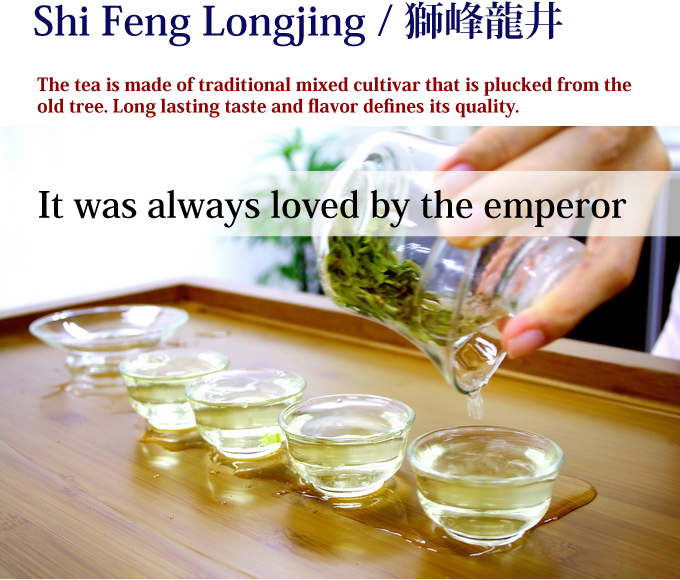
Ever since tea was found, over the past few centuries until now, China has produced thousands type of different green tea varieties. Among all the Chinese green tea, Long Jing is second to none. Long Jing became famous because of its production area that is located very close to the big city. The tea garden of Long Jing is located just beside Hangzhou city, one of the most well developed cities in China. On top of that, the Long Jing production area is also very close to the large cities such as Shanghai and Suzhou. The supply of Long Jing is very limited and seasonal, yet many people rave about this tea and always looking for it. No doubt it is indeed very famous and exclusive. In China, there are many other kinds of nice green tea. But most of them are produced in the tea gardens located deep in the mountainous areas. No matter how good their quality is, they could not be as famous as Long Jing since the production area is too far away from the big cities.
 |
 |
|
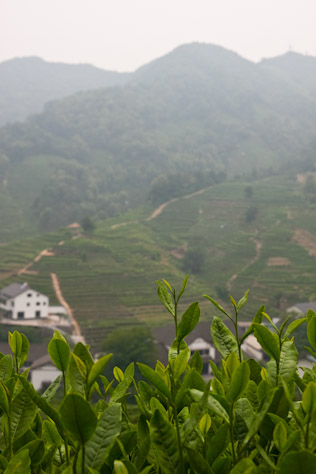
The highest peak of Shi Feng mountain is at around 300m. |
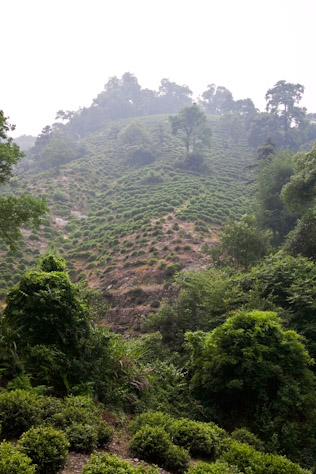
The real Longjing production area is located deep inside and unlike other areas, there is no tourist in this place. |
In the past and even until now, tea has been always used as a gift especially for diplomatic mission. Green tea is always highly esteemed because of its freshness. If the tea is produced from the gardens situated far away the big cities, it lost its freshness during the long route and it won’t be appreciated anymore. This is the reason why Long Jing produced nearby big cities is the top green tea superseded any other Chinese green tea.
Due to its fame, the demand of Long Jing kept increasing and the production of this tea has spread out to many other places besides Hangzhou. Nowadays, Long Jing is found not only in most of province in China, the tea gardens in Taiwan and even India are producing Long Jing tea as well. Under the circumstances, the authentic Long Jing that produced in historically famous area is named after the production area. The most famous Long Jing in commercial tea market is generally named as Xi Hu Long Jing. It is produced at the tea garden situated nearby the West Lake (Xi Hu) in Hangzhou. Among Xi Hu Long Jing, the most famous Long Jing is called Shi Feng Long Jing. It has gained its fame and recognition among tea connoisseurs because of its superb quality. This is the tea that we are introducing.
Why Shi Feng Long Jing is the best?
What is so good about this tea?
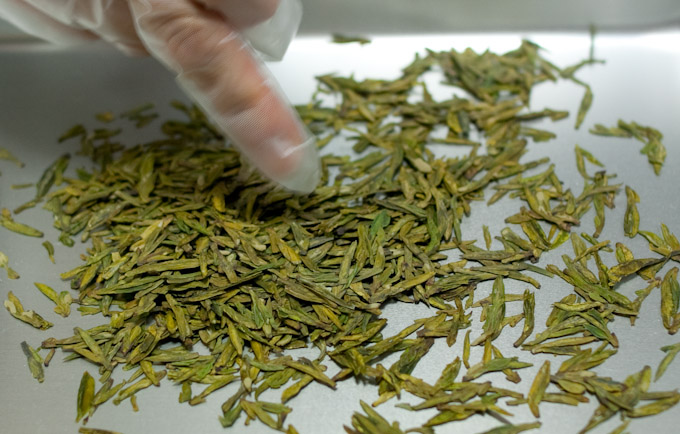
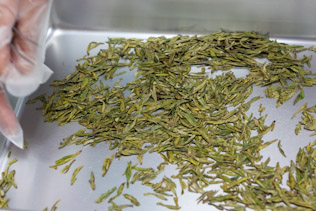
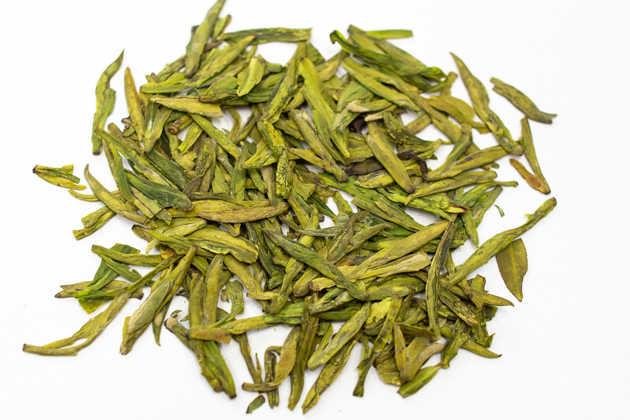
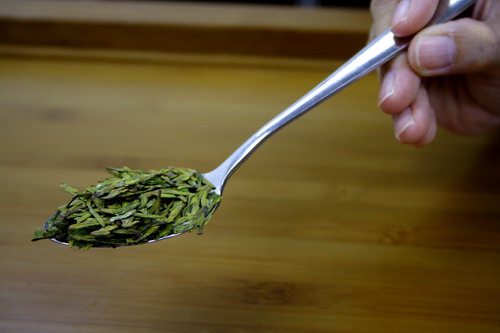
We carry out manual inspection before packing: The leaf of Shi Feng Long Jing is in yellowish color. The long jing that color is very bright green is either made in other production area like Mei Jia Wu or made of 2nd or 3rd plucked tea leaf.
 |
 |
|
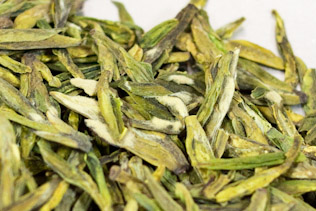
| You can observe how small our long jing leaf. The size is very important criteria to judge the timing of plucking. | High grade long jing contains white lump. Many customers misunderstand with spider web or foreign material. In fact it is the hair from leaf bud itself. Young tea bud of earliest up-coming spring crop is covered with tiny hair. During rolling process, hair came off from the tea leaf and roll up in white ball. It is one of the quality index of Long Jing. |
In English, Xi Hu means West Lake. This is a renowned production place for quality Long Jing. Other than Xi Hu, the most famous production area is Shi Feng. In English, Shi Feng means Lion Peak. Shi Feng is located in Long Jing village. This place has a very long history in producing Long Jing, and there is the original tea tree that was the tribute tea for the emperor of China. Although Shi Feng Long Jing is already one of our existing line-ups, it is extremely high price and one would not be able to take it as a casual daily drinking tea. Under the circumstances, we introduced Xi Hu Long Jing that its price is not as high as Shi Feng Long Jing. Although we named it as "Xi Hu", this tea is from the same tea garden for our Shi Feng Long Jing, and it is produced by the same farmer who made our Shi Feng Long Jing. We selected the fresh bud from second flush in order to keep the price lower. The tea is hand-plucked on 20th of April. It gives intermediate extent of aftertaste, with a delightful nutty aroma and a comfortable smooth drinking feeling.
The altitude is the essential factor for quality tea. Tea garden located at higher altitude has a huge temperature gap between day and night. The cold environment at night keeps metabolism of tea tree low. Thus tea leaves can accumulate more substances and minerals to enhance its flavor and taste. The Shi Feng area is at the altitude of about 300m, whereas the rest of tea gardens in Xi Hu area are at altitude around 100m.
However some of the tea gardens in other provinces of China are located at much higher altitude and they also produce so-called Long Jing. But their Long Jing quality is not as good as Shi Feng Long Jing. Under the circumstances, the altitude is not the primary factor that contributes to the quality of Shi Feng Long Jing.

In Shi Feng Mountain, there are many different cultivars for making Long Jing. The most well-known cultivar is called Long Jing No.43. This cultivar is famous because of its sprouting season is shifted to 7-10 days earlier than other cultivars. In China, the earlier the Long Jing comes into the tea market, the better the selling price would be. Drinking the earliest harvested tea during spring is a customary culture that people are fond of. Therefore, cultivar No. 43 is highly appreciated by farmers because of it can generate higher income. This has driven to the situation that a lot of farmers removed local native cultivar and replanted cultivar No.43. As a matter of fact, early plucking can be carried out because of tea leaves grow faster. Just like the vegetable cultivated in the green house in order to promote a faster growth rate, it results in the taste of vegetable becomes thinner. The quality tea must be given sufficient time to grow slowly so that its flavor and taste becomes very rich.
The most native local cultivar is called the mixed-cultivar. It is called mixed-cultivar because they consist of a few types of hybrid cultivar on account of random cross-breeding in the history. It was the first generation of tea planted by the ancestors of Long Jing area. In general, the mixed-cultivar produces much longer root than the modern cultivar like Long Jing No. 43. Because of this reason, the mixed-cultivar has a greater ability to absorb minerals from the ground. In addition, the growing rate of mixed-cultivar is slower than modern cultivar and the number of leave is also lesser. As a result, the taste and flavor of tea becomes very much superior compared to modern cultivar.
Nowadays, only very limited number of old tea trees remains in Shi Feng Mountain and these are the mixed-cultivar. Shi Feng Mountain might have been the first place where tea is planted in the history of Long Jing. Some of tea trees are more than 100 years old. The old tree has much stronger and longer roots than young tree.
Nevertheless there are mixtures of old tree and newly planted cultivar such as Long Jing No. 43 in Shi Feng Mountain. In order to make sure we obtain our desirable quality, we specify the type of tea tree from the highest altitude of tea garden at Shi Feng Mountain. We even made a reservation one year in advance so as to make sure we obtain the best quality material.
We did not intend to go after the fame of Shi Feng. Our selection happens to be Shi Feng after we carefully investigate the essential factors that contribute to the quality Long Jing. Due to its fame, the price for Shi Feng Long Jing is very expensive. In fact, Long Jing tea from the 2nd and 3rd plucking is much cheaper. The 2nd and 3rd plucked tea consists of bigger leaves in length, uneven shape and size, and it gives less depth in taste and flavor, yet it has intense aroma and slight bitterness.
Long Jing is a historical tea in China. The making of Long Jing was dated back to 1,500 years ago. It is said that Long Jing was already recorded early in Song Dynasty in the world’s first tea book, Cha-Jing (茶经, The Tea Scripture written by Lu Yu 陆羽). Once upon a time, it was named according to the name of mountains, 香林茶 (Xiang-lin-cha), 白云茶 (Bai-yun-cha), and 宝云茶 (Bao-yun-cha). Long Jing tea started to bloom during Yuan (元) and Ming (明) Dynasty. It was named as Long Jing since Song Dynasty. The name of Long Jing was well-known during late Qing Dynasty (清代). It is said that during the Qing Dynasty, Emperor Qian-Long (乾隆) visited the Shi Feng Mountain, and was served with a cup of Long Jing tea. He was very impressed with its beautiful appearance, elegant fragrance and mellow taste. The monk who served the tea explained and brought him to the tea garden. At that time, there were planted 18 tea trees. While the emperor was enjoying plucking the tea leaves, urgent news arrived saying the Queen Mother had fallen ill and urged the emperor to return to the palace. When the emperor visited the ill Queen Mother, the strong fragrance of tea leaves that he kept in his pocket attracted the Queen Mother’s attention. Without second a thought, he served the tea to the Queen Mother, and she fell in love with its pleasant taste and flavor. After drinking the tea for several times, the Queen Mother was cured. The Emperor was very grateful, and granted the 18 tea trees in Shi Feng Mountain as the Imperial Tea Tree. Since then, Long Jing became a tribute tea to emperors. Up to date, the 18 tea trees still remain at Shi Feng Mountain.
By far, Long Jing still hold its crown on the list of China Top Ten Teas. It has been appointed as the Nation Tea (国茶 Guo-cha), and was always selected as a gift tea served to foreign dignitaries. Year after year, tea connoisseurs endlessly seek for it and compete to obtain the best Long Jing in tea market. Its fame as the Queen of Green Tea is what every tea connoisseur is fond of.
The original Long Jing is produced in Long Jing Village, which is situated at the shore of Xi Hu (西湖). In history, Long Jing was produced from five different areas, Shi Feng Mountain (狮峰山), Mei-jia-Wu area (梅家坞), Weng-jia Mountain (翁家山) Yun-qi area (云栖), and Hu-pao area (虎跑). Today, Long Jing is categorized into 4 different groups: namely 狮 (Shi), 梅 (Mei), 西湖 (Xi Hu, means West Lake), and Long Jing from other places is called Zhejiang Long Jing (浙江龙井). The tea growing area is surrounded with fog throughout the year. One of the essential factors for good Long Jing is the mellow taste. This taste originates from the amino acid called theanine. Young buds contain high level of theanine, but it is converted to polyphenol such as catechins when tea leaves receive sun light. On the other hand, less sunshine will preserve high levels of theanine in leaves as bio-conversion is not effectively taking place. The area is often covered by fog, which blocks the direct sun light on tea leaves.
 |
 |
|
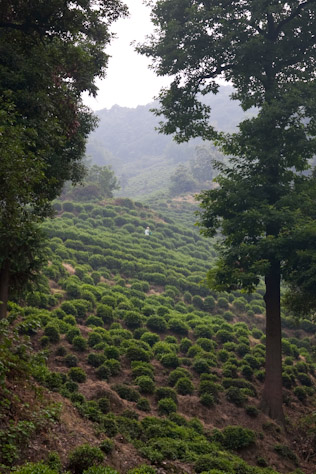
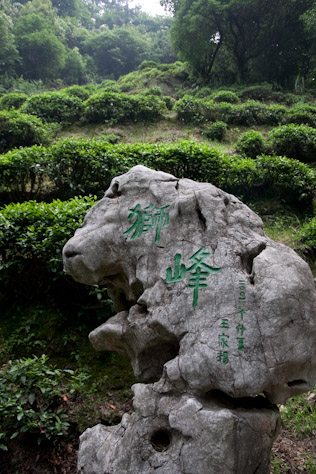
Tea garden that consist of traditional mixed cultivar: The photo was taken at Shi Feng mountain. |
The name "獅峰" means Shi Feng. |
During the early spring, one bud and one leaf or one bud with two leaves (which just starts to open up, called初展Chu-zhan) is hand-plucked. The length of bud is 2.5 – 3.0 cm. The length of bud is an indication reflecting the degree of delicacy (嫩度 Nen-du) of tea leaves:
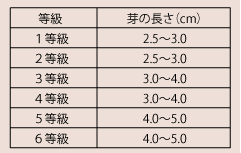
Our product is the first grades, the length of brewed leaves including the bud is below 3cm.
During the early spring, one bud and one leaf or one bud with two leaves (which just starts to open up, called 初展 Chu-zhan) is hand-plucked. The length of bud is 2.5 – 3.0 cm. The length of bud is an indication reflecting the degree of delicacy (嫩度 Nen-du) of tea leaves:
Relationship between the size of bud and its grade
Our product is the earliest plucked mixed cultivar. Thus the length of brewed leaves including the bud is below 3cm. The plucking is carried out at the earliest possible time to harvest the young shoots. It is said that the best time to harvest the best quality of Long Jing is before 清明 (Qing Ming, occurring on April 4 (leap years) or April 5 (other years) of the Gregorian calendar), the product is named as 明前茶 (Ming-qian Cha). Subsequently, tea harvested before Grain Rain (谷雨) is considerably good quality; it is named 雨前茶 (Yu-qian Cha). In a day, even an expert can only manage to harvest as much as 1.0 - 1.5kg of young shoots. In any event, 0.5kg contains about 60,000 pieces of young shoots.
In addition, the tea leaves must be carefully selected during plucking:
 |
 |
|
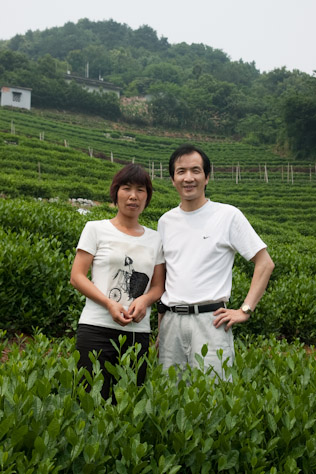
Mr. Kim and his wife. They are the one who produce Shi Feng Long Jing for us. |
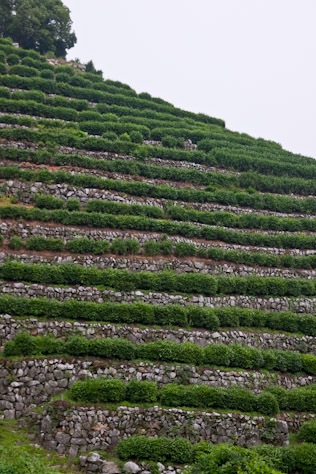
Most tea graden at Shi Feng mountain is situated on rocky environment. |
Tea leaf after plucking is moved into well ventilated room. Tea leaves are spread in a layer of 3-5cm and it is left for 6-12 hours. This process reduce moisture until 70%. Tea leaf reduce greenish aroma & bitterness and increase relative percentage of amino acid.
During the first pan frying, the purpose of 殺青 is to inactivate oxidative enzyme such as polyphenol oxidase (PPO) with heat, as well as forming the preliminary shape of Longjing. With high temperature, it takes a very short time to heat the tea leaves and inactivate oxidative enzyme. When the temperature reaches 80-100˚C, place about 100 g of tea leaves into the pan, and fry by hand. At the start, the main hand-gesture is to grasp the leaves up to about 10 cm in height away from the pan and slowly sprinkle the leaves to vaporize the moisture from the leaves. After frying for 3 – 4 minutes, the leaf turns soft. By then, the hand-gesture is changed to put-over, press or holds down, shivering and fling or throws off. Progressively increase the pressure by hand. This step is important to form the preliminary shape of Longjing. The leaves are straightened into narrow-shaped strips and flattened. The skillful tea master has to carefully manage the timing of action and pressure induced by hand: too much pressure, incorrect hand motion and if pressed too soon, tea leaves become dark in color; on the other hand, if leaves are not straightened and flattened indicates that the hand pressure applied is insufficient and/or the pressing is carried out too late.
After frying for 12 – 15 minutes, when the moisture content of leaves is reduced to 20-30%, remove the leaves from pan.
The fried leaves are spread out to 15 – 20 cm and cooled down for about 40 - 60 minutes. At this time, the leaf re-absorbs moisture and softens (called 回潮Hui-chao).
After cooling, the softened leaves is winnowed to remove broken and light pieces of leaves, and hand-sorted to get rid of dull, burnt, yellow pieces, red colored leaves and stalk, stalk which is too long, and any foreign materials. Subsequently, the sorted leaves are sifted to obtain the first batch of leaves that is retained on the top sifter, while the leaves that pass the sifter is collected and sifted again to obtain the second batch which is retained on sifter and third batch, i.e. leaves pass the sifter. These three different batches of leaves will be preceded for second frying separately.
The purpose of second pan-frying is to form the shape and to further remove moisture. Usually, about 4-5 batches of tea leaves from 1st heating are gathered together and proceed for second heating. The collected leaves are about 250g in total. The initial temperature of pan is about 60 – 80˚C, fry leaves until they are heated up and softened, and down reveal (露茸毛 Lu-rong-mao), then increase the temperature to 80 – 90˚C, and continue frying. When down drops and leaves are tightened up to flat and smooth strips, the temperature is reduced to 50˚C.
During frying, the pressure induced by hand is gradually increased. It involves the hand action of put-over, buckling, rubbing, press, and push. The gist of the matter is the leaves must always be in contact with the hands, and the tea leaves should not be away from the pan. Toasting is continued until the down drops from the leaves, and leaf becomes flat, smooth and sleek. When the leaves emit their own fragrance, and could easily fracture, and the moisture content is reduced to 5 – 6%, the frying is then sufficient. It takes 25 minutes of frying in total.
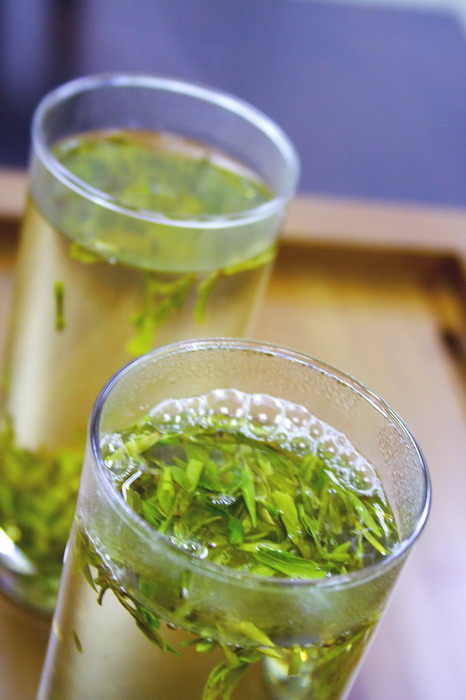
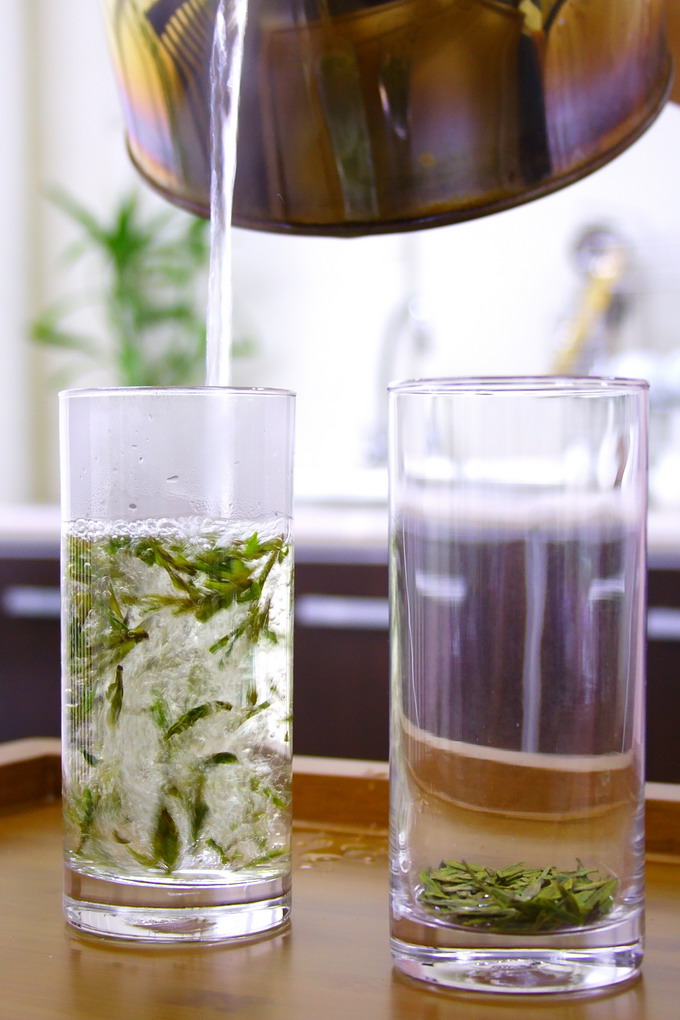
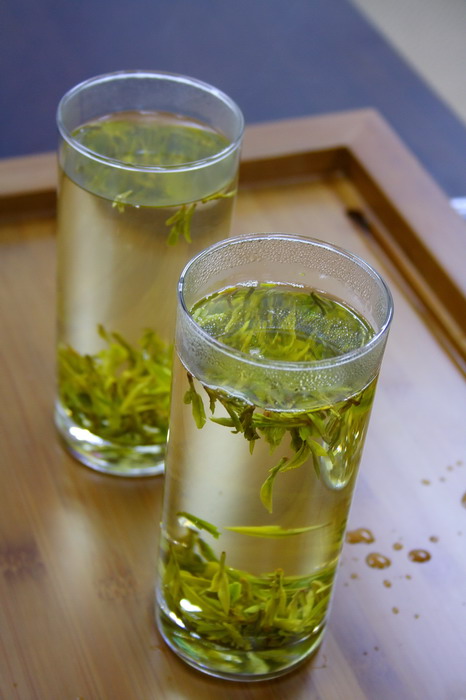
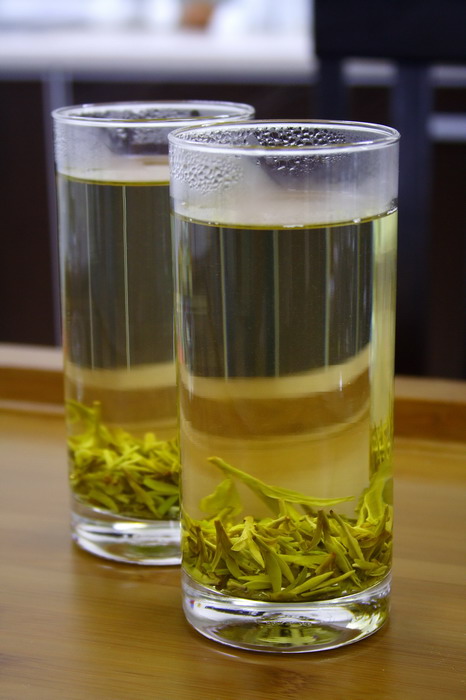
It is nice to brew Long Jing in long glass. It is suitable as you can observe tea leaves and enjoy how they move up and down. This method is often used when people enjoy long jing in the office.
Go to further information about suitable water for brewing tea >>
In you are using tap water, it is necessary to filter the water using an activated carbon filter. If not, you wouldn’t be able to enjoy the authentic taste of tea. Chlorine is added to tap water in order to sanitize bacteria. This chlorinated water will also harm our body cells. Concerning about our health condition, it is very important to remove chlorine from drinking water. The most effective method in removing chlorine is to install an activated carbon filter. This type of filter is designed for removing organic substance. It will remove not only chlorine, but also other harmful substance such as contaminated pesticide. The activated carbon filter can be easily obtained from the common hardware shop in most countries. If activated carbon filter is not available, please place a charcoal inside the water and leave it for over night. The material composed of activated carbon filter is made of ground charcoal. The difference is that activated carbon filter contains much finer particles and hence it has extremely large surface area for a better efficiency in filtration. We do not suggest RO water (reversed osmosis water) or distilled water. This water carries no mineral, the taste and flavor of tea tends to be very unstable, unless you have very superior quality tea and tea equipment.
In the long run, you may observe a thick layer of scale accumulated inside your kettle. Our mother usually taught us to wash and remove it with citric acid. But please do not even try to remove the scale. Scale consists of minerals that exist in the water. The mineral composition is reflected from the water you used. If you remove the scale, the mineral ion balance between scale and water is destroyed. This balance is called buffer effect in science. The flavor and taste will seriously run out and you won’t be able to get previous taste and flavor for a long time. It is also important to stick to the same type of water whenever brewing tea. If source of water is changed, it carries different type of minerals. It will affect the mineral ion balance too.
Go to further information about suitable water for brewing tea >>
Water must be boiled once in order to reduce the softness of the water. Let water cool down until 80-85 degree C and use it for brewing.
The most suitable way to serve Longjing is using a long glass. The long glass is often used for serving Chinese green or yellow tea. It is advisable to select a glass that is clear without any decorative design and transparent. With this glass, it is best to observe and enjoy the beauty of Longjing when being brewed.
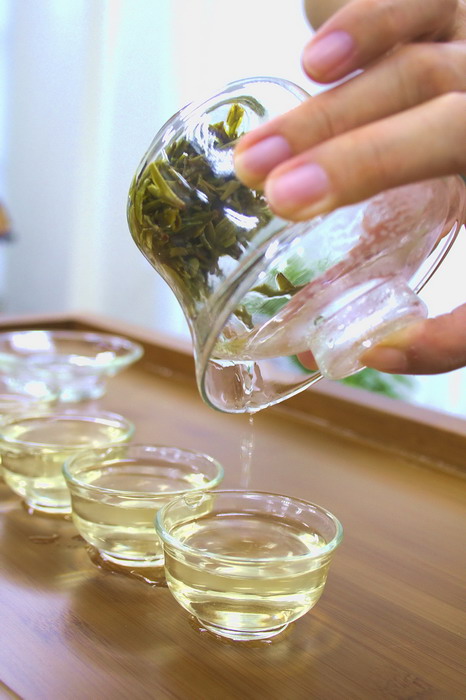
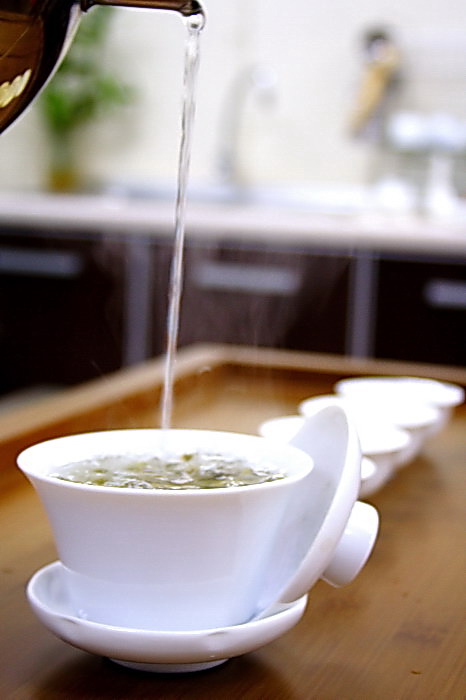
The method of brewing Longjing is named as "Down-Tossing Infiltration Brewing". The leaf of Longjing is in flat shape and therefore difficult to sink when brewed. With this brewing method, the leaf is brewed "twice": firstly, the leaf is moistened with a small quantity of water and to let it unfold followed-by the addition of water to make up a cup of tea. The details of preparing Longjing following Down-Tossing Infiltration Brewing method is described as below:
You can refill hot water over and over again. Since it is a very expensive tea, we shall brew more than 5-6 times at least
Hot water: leaf weight = 1:50 (4g of leaf for 200ml of water)
Temperature: 80-85 degree C
Once a bag of tea is opened, please finish it within 3 months if you wish to enjoy its freshness. From the medical point of view, it is safe to consume the tea even if it is kept for a few years. However the freshness disappears if it is kept for too long. Tea must be tightly sealed before it is kept. Tea should be kept in ambient and dry conditions such as in the living room, but it must be completely away from humidity. Tea should not be kept in the kitchen as the environment is very humid. Avoid enclosed area such as inside the cupboard or drawer as these places are damp. Also avoid opening the bag of tea in humid atmosphere. It is recommended to open the bag during a sunny day or under air-conditioned atmosphere. Once tea leaves absorb moisture, deterioration of tea will be triggered within a few days. Tea will then give an astringent taste, sometime it tastes sour. The fresh aroma also becomes weaker.
The quality of tea lasts longer if it is kept in the fridge. However we strongly recommend you not to keep tea in the fridge. When tea is withdrawn from the fridge, there is usually condensation. Once tea is exposed to moisture during condensation, the quality will deteriorate within a few days. The higher moisture content in the tea leaves will trigger oxidation and it will completely destroy the quality of tea.
Here's one frequently asked question: what happens if bag is sealed using tape or tea is packed in zipper bag and kept inside the fridge?
For your information, these simple sealing methods are not sufficient. When the bag is withdrawn from the fridge, it is cold inside the bag and therefore causes negative pressure. Air will be drawn from outside and condensation will occur. In addition, if the bag is taken in and out from the fridge very often, this will cause heat stress to the tea leaves as temperature is increased and decreased very frequently. If tea is kept in the fridge, when it is withdrawn from the fridge, it is necessary to leave it in ambient atmosphere for more than 24 hours in order to warm up the tea leaves. Based on our experience, 12 hours is not long enough. We may think tea is warmed up, but inside the bag, the tea leaves are still cold due to insulation effect.

Please feel free to send us e-mail for enquiry at:

 |
We accept various kinds of credit card through Paypal.
Only if customer prefer other option of payment, we suggest "Bank Transfer".
Various choice of shipping method
EMS, SAL, Small Packet, Small Packet (SAL) Yamato Express and Surface
For shipping tea, we usually suggest small air parcel, the estimated shipping cost of tea in 100g (with wrapping material ) is
Small Parcel
USA JPY 600, EU JPY600 and Asia JPY470
Small Packet (SAL)
USA JPY380, EU JPY380 and Asia JPY320
The shipping fee to oversea by small air parcel happens to be even cheaper than domestic shipping fee in Japan.
For your information, some countries, EU in particular imposes custom duty. We need buyer to bare the duty. We are sorry, but we cannot change the amount on the invoice, and we do not mark any packages as gifts. We will strictly follow the custom regulation.
 日本語サイトへ