

Thank you for visiting HOJO website. If you have any enquiry, please feel free to get in touch with us at

▼ Akira Hojo
▼ Hojo Newsletter
▼ HOJO FACEBOOK






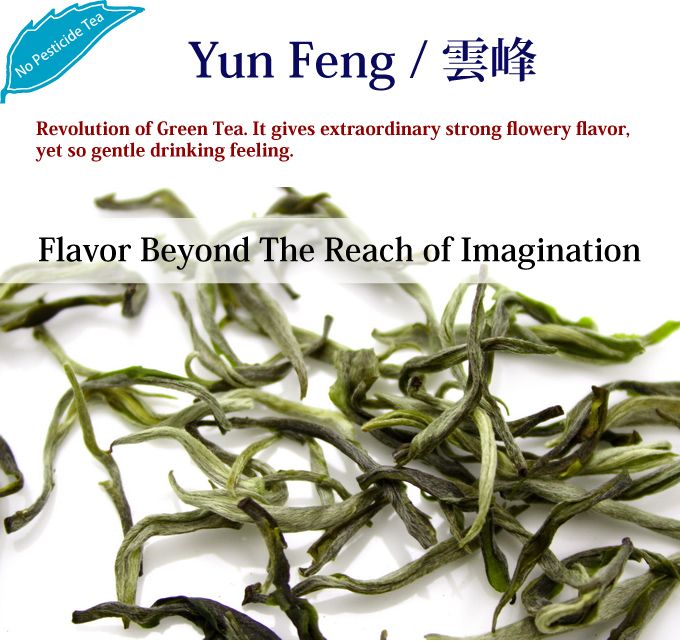
The characteristic of this tea is far different from ordinary green tea both in Japan and China. It shows a little similar characteristic as Darjeeling 1st Flush as you get impressed with its overwhelming flowery flavor. When its mellow and delicate drinking feeling comes with flowery flavor, it reminds us of Spring Flower.
The special characteristic of this tea is made by long-hour withering, which reduce the bitterness and astringency of tea and enhance the flowery flavor and sweet taste. This character is a little similar to the spring black tea such as Darjeeling 1st flush. This tea is also very delicious to drink in cold.
Sometimes our customer think that Green Tea = Japanese Tea. In fact, more than 70% of Chinese Tea is green tea.
It is not too much to say that the history of famous Chinese Tea is the history of Green Tea.Yun Feng is only one of a few thousands Chinese Green Tea, yet we fall in love with this tea. Why? It is because of its very unique flavor.
We are purchasing this tea directly from the owner of tea garden. In the history, this tea has never been introduced in both Japan and Malaysia. In our brand, it is one of the very popular green teas.
You can brew this tea at least 3-4 times. Usually you can brew 1 liter of tea from 3g of tea leaf. Is not it quite economical?
Yun Feng is produced from the Switzerland IMO certified organic tea garden located at Guangxi, China (広西壮族自治区). One of the sweet taste of green tea is originated from the amino acid called theanine.
The name of Yun Feng derives from the location of tea garden. The peak of mountain where tea garden is located is higher than cloud. At high elevation, there is a huge temperature gap between day time and night time. In a day time, there is sufficient sun light and tea leaves vigorously produce plentiful of substances such as poly phenol, which are essential for the exclusive quality of tea. At night, if the temperature is high, the metabolism is continuingly taking place, and tea leaves will consume the substances that were produced during the day time. However, at the high elevation at mountain area, the lower atmospheric temperature at night caused tea leaves became less active and therefore those substances are remained in the leaves. With these factors, tea leaves are very rich in substances that contribute to the good quality of tea.
Tea is made of big leaf cultivar. This tea contains methylated catechin and therefore it is usually giving astringent taste. However, Yun Feng is not astringent at all as its process involves long-hour withering. Beside, methylated catechins which gives astringent taste is also known as effective in getting rid of allergy in human body.
Plucking of tea leaves begin in early March in order to select young and tender leaf. All the processes are carried out by hands. Only one bud and 2 leaves is carefully plucked, while insect attacked leaves and damaged leaves are avoided during plucking.

The identical character of Yun Feng is strong flowery flavor with mellow and sweet taste. The secret in making the taste of Yun Feng so sweet and flowery is laid on withering process. After harvesting, tea leaves are spread into a thin later inside the factory. Withering means dehydration of leaf. When tea becomes dehydrated, tea leaf feels stress and it triggers moderate fermentation. The cell of tea leaf is still alive, yet tea leaf is getting fermented. As a result, most of the astringent substances such as methylated catechin become partially oxidized and instead it generates flowery aroma and flavor.
When tea leaf is well withered and start producing flowery aroma, tea leaf is fried in order to inactivate the enzyme. Tea leaves are then cooled down and transferred to rolling process. If rolling is too strong, tea leaf is compressed and taste is not refreshing. If rolling is insufficient, tea is giving less taste. Therefore, adjusting the pressure during rolling process is a very important factor. After rolling process, tea is sent for drying.
This tea is process in a similar style as Darjeeling First Flush in terms of conducting long withering process. In fact, withering is one kind of minor fermentation. In this regards, Yun Feng may have a slight similarity with White Tea and Oolong Tea.
Go to further information about suitable water for brewing tea >>
There are many methods to brew this tea. Using a tea pot, we can get the most stable and nice taste. However we would also like to introduce conventional brewing method using the long glass. Regardless of the method, the key point is managing the brewing temperature. The higher the temperature is the bitter the taste becomes. The optimum temperature is about 85 Degree Celsius.
In you are using tap water, it is necessary to filter the water using an activated carbon filter. If not, you wouldn’t be able to enjoy the authentic taste of tea. Chlorine is added to tap water in order to sanitize bacteria. This chlorinated water will also harm our body cells. Concerning about our health condition, it is very important to remove chlorine from drinking water. The most effective method in removing chlorine is to install an activated carbon filter. This type of filter is designed for removing organic substance. It will remove not only chlorine, but also other harmful substance such as contaminated pesticide. The activated carbon filter can be easily obtained from the common hardware shop in most countries. If activated carbon filter is not available, please place a charcoal inside the water and leave it for over night. The material composed of activated carbon filter is made of ground charcoal. The difference is that activated carbon filter contains much finer particles and hence it has extremely large surface area for a better efficiency in filtration. We do not suggest RO water (reversed osmosis water) or distilled water. This water carries no mineral, the taste and flavor of tea tends to be very unstable, unless you have very superior quality tea and tea equipment.
It is also advisable not to use fresh tap water. The intensity of after taste becomes stronger if water is kept overnight. Keeping water with stones or inside clay jar will increase the content of minerals. However, you need to confirm whether or not the water kept inside particular jar or with stone is suitable with your tea or tea equipment (such as teapot). If water jar carries certain minerals like copper or zinc, it will rather spoil the taste and flavor of tea. For this, you need to confirm with experiment on try and error basis.
For boiling water, please do not use aluminum or copper kettle. It spoils the taste of water. We suggest using kettle made of iron, stainless steel, tin or glass.
In the long run, you may observe a thick layer of scale accumulated inside your kettle. Our mother usually taught us to wash and remove it with citric acid. But please do not even try to remove the scale. Scale consists of minerals that exist in the water. The mineral composition is reflected from the water you used. If you remove the scale, the mineral ion balance between scale and water is destroyed. This balance is called buffer effect in science. The flavor and taste will seriously run out and you won’t be able to get previous taste and flavor for a long time. It is also important to stick to the same type of water whenever brewing tea. If source of water is changed, it carries different type of minerals. It will affect the mineral ion balance too.
Brewing Method 1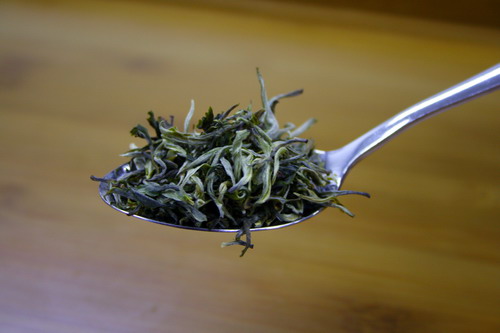
Prepare 3 g of tea leaves for 150 to 200ml of water. The photos shows one table spoon of tea leaf which is about 3g. The quantity of tea leaf used can be adjusted based on one's preference on the taste. |
Brewing Method 2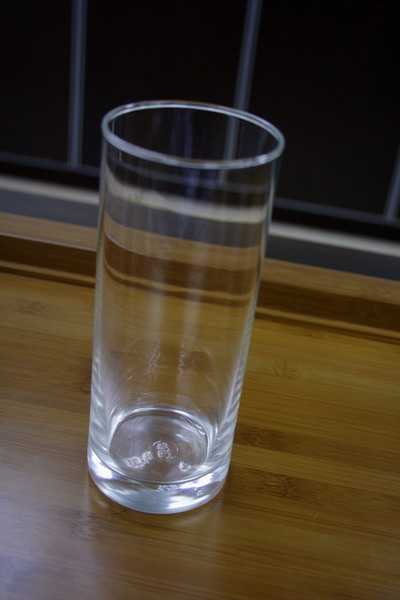
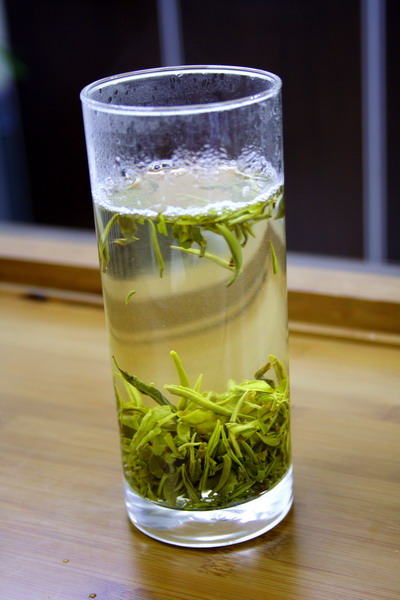
The suitable way to serve Yun Feng is using long glass. The Long glass is often used for serving exclusive Chinese green or yellow tea.It is also convinient for office use. |
|
Brewing Method 3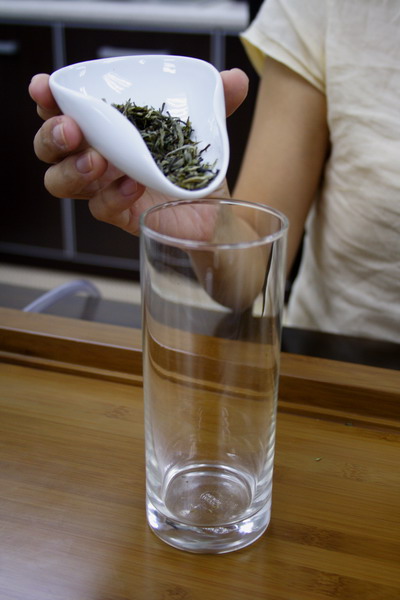
Place 3g of tea leaf into 150m-200ml of water. |
Brewing Method 4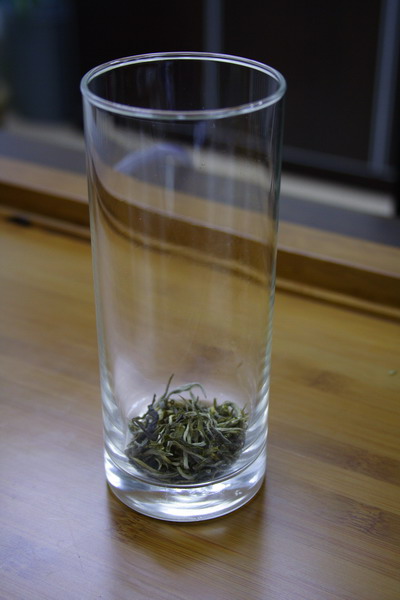
In the Long Glass, the quantity of tea leaf used is covering the bottom part of glass. |
|
Brewing Method 5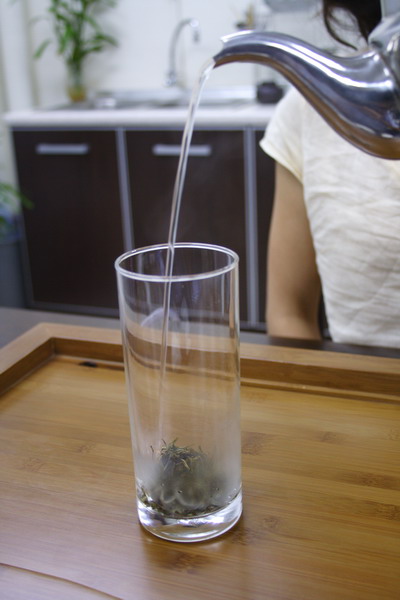
Pour boiled water and allow cooling to 80-90 degree C.. Green tea leaves prefer a slightly cooler temperature as compare to black tea in order to minimize the extraction of polyphenol that gives bitter taste. |
Brewing Method 6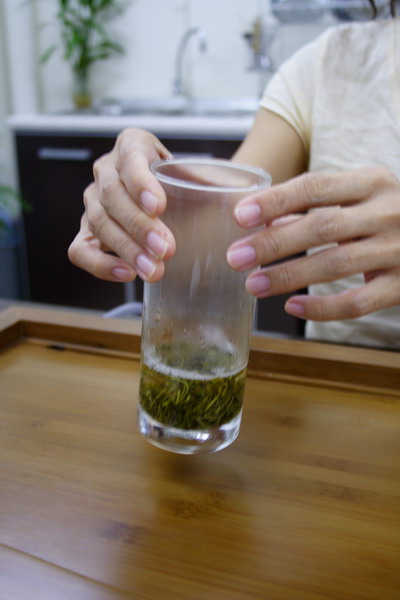
Sway the glass in a gentle movement to let all leaves moisten and infiltrate. It is time to briefly enjoy the fragrance but not to drink yet. |
|
Brewing Method 7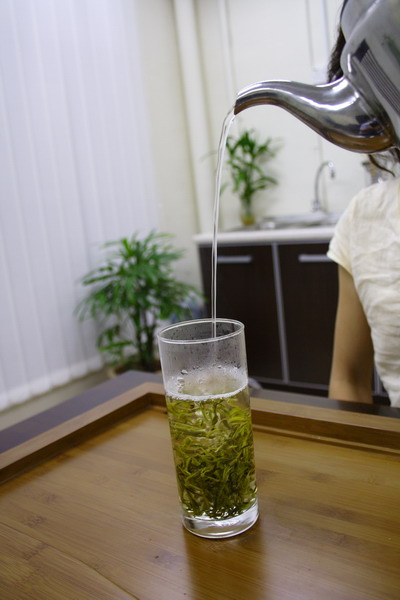
After one minute, pour in another 100 ml of water. |
Brewing Method 8
Brew for 2 minutes and serve. If the taste is too strong, add boiled water to the glass.
|
Once a bag of tea is opened, please finish it within 3 months if you wish to enjoy its freshness. From the medical point of view, it is safe to consume the tea even if it is kept for a few years. However the freshness disappears if it is kept for too long. Tea must be tightly sealed before it is kept. Tea should be kept in ambient and dry conditions such as in the living room, but it must be completely away from humidity. Tea should not be kept in the kitchen as the environment is very humid. Avoid enclosed area such as inside the cupboard or drawer as these places are damp. Also avoid opening the bag of tea in humid atmosphere. It is recommended to open the bag during a sunny day or under air-conditioned atmosphere. Once tea leaves absorb moisture, deterioration of tea will be triggered within a few days. Tea will then give an astringent taste, sometime it tastes sour. The fresh aroma also becomes weaker.
The quality of tea lasts longer if it is kept in the fridge. However we strongly recommend you not to keep tea in the fridge. When tea is withdrawn from the fridge, there is usually condensation. Once tea is exposed to moisture during condensation, the quality will deteriorate within a few days. The higher moisture content in the tea leaves will trigger oxidation and it will completely destroy the quality of tea.
Here’s one frequently asked question: what happens if bag is sealed using tape or tea is packed in zipper bag and kept inside the fridge?
For your information, these simple sealing methods are not sufficient. When the bag is withdrawn from the fridge, it is cold inside the bag and therefore causes negative pressure. Air will be drawn from outside and condensation will occur. In addition, if the bag is taken in and out from the fridge very often, this will cause heat stress to the tea leaves as temperature is increased and decreased very frequently. If tea is kept in the fridge, when it is withdrawn from the fridge, it is necessary to leave it in ambient atmosphere for more than 24 hours in order to warm up the tea leaves. Based on our experience, 12 hours is not long enough. We may think tea is warmed up, but inside the bag, the tea leaves are still cold due to insulation effect.

Please feel free to send us e-mail for enquiry at:

 |
We accept various kinds of credit card through Paypal.
Only if customer prefer other option of payment, we suggest "Bank Transfer".
Various choice of shipping method
EMS, SAL, Small Packet, Small Packet (SAL) Yamato Express and Surface
For shipping tea, we usually suggest small air parcel, the estimated shipping cost of tea in 100g (with wrapping material ) is
Small Parcel
USA JPY 600, EU JPY600 and Asia JPY470
Small Packet (SAL)
USA JPY380, EU JPY380 and Asia JPY320
The shipping fee to oversea by small air parcel happens to be even cheaper than domestic shipping fee in Japan.
For your information, some countries, EU in particular imposes custom duty. We need buyer to bare the duty. We are sorry, but we cannot change the amount on the invoice, and we do not mark any packages as gifts. We will strictly follow the custom regulation.
 日本語サイトへ